It’s Alive! A New Approach to Communications

Frankenstein: "The Web: It's Alive!"

Nearly every organization I’ve worked with over the last few years has been in the midst of a communications culture change. These organization had mastered the art of print-based communications and marketing. However, it was time to dive in to a new, integrated approach to online and print communications and marketing.

By necessity, print-based approaches require tons of checks to ensure accuracy and consistent style. Once a project goes to print, there’s no going back — it’s done. Moving print projects through several layers of editing, copy editing, proofreading and approvals helps ensure accuracy. The upside, the opportunity for extremely consistent branding and style from project to project, often contributed to a downside: slow project timelines.

Today, web communications and marketing requires a new approach. Because the web is essentially a series of living documents, web projects shouldn’t follow exactly the same processes as print projects. Sure, it’s a good idea for a few layers of editing and approvals to remain in place, but the first version you post online doesn’t have to be the last version. For example, the web is great for real-time communications. When an emergency arises, it’s okay to post something quickly and then adapt and refine your response as more information becomes available. Similarly, now that we have web analytics at our disposal, publishing a new page is usually the starting point for optimizing the content to the audience’s needs.

On the flip side, once you publish something online, it can live on in cyberspace forever. But for most routine web communications projects, so what? Yes, someone could see that you changed the location for an event or corrected a typo. But users today expect up-to-the-minute information, and that includes the expectation that the web changes from day to day.

If you’re in the midst of transitioning from a print-heavy approach to an integrated online/offline approach, take heart. The web is alive, and this isn’t a scary idea — it’s an exciting opportunity to try out a new approach.

Online Learning and edX

In 2008, I served as project coordinator as the graduate school I worked for redesigned and relaunched its .edu website (see the website). But we didn’t stop there. We ended up launching three other new sites at the same time (Worldwide Classroom, Resources for Life, and Living Christ Today). It was a great experience that piqued my interest in web communications and provided opportunities to learn quite a bit about web analytics, information architecture, user experience and best practices for web content.

Working on the Worldwide Classroom site opened my eyes to the world of online learning. At the time, I knew that many higher education institutions offered distance learning, but there were really only a few institutions that were brave enough to try offering free online learning. Even MIT had only launched its OpenCourseWare site in 2002.

edX logoThis week, MIT and Harvard announced edX, a new online learning initiative. This partnership will support the development of a new online learning platform. edX will soon invite other institutions to participate by sharing free course content on the open-source platform.

This is significant news. These institutions made hefty investments in the initiative, and they can offer excellent content. Free and paid online learning will certainly continue to be hot topics for the next few years. And if these institutions can successfully deliver education online, then what’s to stop other industries from doing the same? For example, we could see health care groups (e.g., payors, providers) test out online health education programs.

However, some questions remain: Is edX truly an altruistic venture, or will it begin to generate revenue at some point (e.g., through advertising, selling lists, etc.)? Will the platform take off? If so, who will use it? Will users really learn via edX, and how will they know when they’ve mastered a subject?

Read more about edX and online learning:

Becoming an Optimizer

There’s always room to improve. Sometimes it’s a matter of finding your stride as an individual or as a team, and sometimes it’s a matter of allowing the idea/process/system to evolve. Cases in point:

  • Posterous began as an online photo sharing service. By leaving room for their core idea to change over time, the company, which was acquired by Twitter in March, eventually evolved into a micro-blogging and life streaming platform with a committed user base.
  • The first time I heard the Arcade Fire live, in June 2004, I wasn’t wowed. But by the time I heard them again in November 2004, their team (and therefore their music) had coalesced in a new way. It was amazing. (Or, maybe they had an off night in June!)

Neither Posterous nor the Arcade Fire struck gold on their first try. So why do I continue to think that I’ll strike gold on my first try? And why do you continue to think that you will? Isn’t it more important to be open to the changes that come along and actually put in the hard work necessary to grow a B+ idea/system/product into an A one?

Whether you’re interested in optimizing your personal life, your professional life, a product, idea or system, it’s most important to get out there and get started. Here’s what I recommend:

  1. Do something.
  2. Evaluate what you’ve done.
  3. If you liked it and/or it was a good idea, then build on it and keep going.
  4. If you didn’t like it and/or it was a bad idea, then try something else.
  5. Repeat.

Setting Goals: Sustainable is Best

Over the last few weeks, I’ve had several conversations with people who are interested in establishing a basic plan for web communications and social media. We’ve all read articles that mandate certain approaches: blog daily, tweet six times per day, post Facebook page updates five times per week. These goals are great … for some organizations. However, the best goals and approaches for your organization are those that are sustainable in your context.

Just getting started? The best approach might be to start out by focusing on one platform. It’s okay to say that for your organization and your context, publishing a blog post once a week is a success. Once you’re up and running and consistently hitting your goal, then you can consider whether you want to stick with your current approach or set a new goal.

Sustainable and realistic goals lead to lasting success. Don’t let Mashable dictate what works best in your context.

Read and Learn: Good to Great

I’m having a hard time narrowing down my thoughts on Good to Great by Jim Collins. To be honest, each of the six sections of the book could comprise its own post. In this book, Collins, who also wrote Built to Last, sets out to study how companies could achieve enduring greatness. In the process, his research team uncovers 11 companies that made the jump from good (or even mediocre or bad) to great. They then interview executives from these 11 companies to try to tease out similarities that contributed to their greatness. The six concepts fall into three categories: disciplined people, disciplined thought and disciplines action. I’ll limit myself to comments on two of these concepts.

First who … then what
The good to great companies “first got the right people on the bus (and the wrong people off the bus) and then figured out where to drive it.” Moreover, Collins observes that “the right people don’t need to be tightly managed or fired up; they will be self-motivated by the inner drive to produce the best results and to be part of creating something great.” When you think about it, this approach makes a lot of sense. If you have the right team of adaptable individuals working together, then you have a lot of freedom to remain nimble and change direction as needed.

The Hedgehog Concept
This piece is all about determining a core idea that unites your team’s passion, your team’s unique expertise and determining your company’s ultimate economic denominator. It’s the core idea that drives the business. It can be extremely simple. Collins notes that determining the Hedgehog Concept can be an iterative process that takes time. On average, he says, the 11 good to great companies took four years to find theirs. Finally, once you uncover your Hedgehog Concept, you reach the hardest part — sticking to it, even when flashier ideas pass by.

Does either of these concepts ring true to you? How have you seen them play out?

Crowdsourced Funding for Organizations

Kickstarter has really taken off over the last year or so. Since its inception in 2009, the self-described “funding platform for creative projects” has helped coordinate funding for more than 10,000 ideas. Proposals span from indie films to art projects to tech innovations to music projects. In 2011 alone, backers donated nearly $100 million and nearly 50% of the projects proposed on the platform successfully attained full funding.

Other platforms for crowdsourced funding, including DonorsChoose, have also gained some traction. DonorsChoose targets donors with a different interest — helping classrooms in need of supplies. In Madison alone, 21 teachers have proposed projects that would help fund everything from beanbag chairs for an independent reading area to new musical instruments.

What does this mean for organizations? Crowsourced funding platforms can unite two key groups — donors who know and love you and your organization and donors who are passionate about a particular topic or idea. For those who are already familiar with your organization, a public platform for funding a specific project could provide these donors a home base that would allow them to share their passion for your organization with friends and family members. By tapping into an existing platform, you can also reach out to those who are not yet familiar with your organization, but who are passionate about your project’s topic.

Consider the following ideas:

Create a crowdsourced funding platform for your organization.
Lots of organizations and nonprofits have been looking for ways to use their social media communities to drive fundraising. Adapting or building a Kickstarter-esque platform for your organization could provide the structure and home base needed for this type of social fundraising. But, you’ll have to be judicious about determining which projects would work best with this approach. Small, innovative projects with short time frames for funding and implementation would probably be the best fits.

Look for opportunities to use existing crowdsourced funding platforms.
Does your company have an awesome idea for a new technology? Is a group at your school ready to produce a documentary or EP? Send them to Kickstarter and make sure they include information about and links to your organizational website.

Have you considered using Kickstarter, DonorsChoose or another platform for your organization? Have you already implemented this idea? What’s working? What’s not working?

Engaging Students on Their Own Terms

To engage students, you’re going to have to think like a student. Simple, right? Many of the most shared videos in recent years have obviously resulted from meeting students on their own turf. For example, most of the lip dub videos that were all the rage in 2009 and 2010 featured students front and center:


This year, Facebook pages for university-specific memes have been making the rounds. Much like the lip dub videos, these memes are usually a bit crazy and occasionally inappropriate or offensive. Even so, they’re popular with students and easy to share.

UW-Madison-Facebook-meme

When these types of quirky, student-generated content gain traction, it’s time to pay attention. Universities and organizations often end up sounding stodgy. Students sound, well, like students. Consider adapting ideas that are already popular with students. Better yet, coach actual students through the process of making a piece that’s professional enough to represent the organization. It’s win-win: the organization gains a student perspective that will help to engage other students, and the students learn and gain experience.

Read and Learn: Where Good Ideas Come From

I recently finished Where Good Ideas Come From by Stephen Johnson, which focuses on the history of innovation. One of his interesting points is that despite the language we use to discuss inventions and innovations (the “aha” moment, the light bulb coming on, the lone scientist toiling away in his lab), most significant innovations actually result from groups of people thinking over long periods of time. One innovation or realization opens up a whole new world of possibilities. Johnson calls these new possibilities the “adjacent possible.”

This book encourages innovators to read extensively and take notes or journal ideas. In several of the scenarios Johnson shares, innovators mulled over an idea for years before finally hearing or reading something that filled in the gaps in the idea. Innovators in any industry would do well to form habits that encourage these types of long-term thinking and reflection.

Pinterest and Organizations

In 2009, a new social platform entered the scene: Pinterest, a visual pinboard and social bookmarking site. I had used the Notes feature in Google Reader to collect links of personal interest (read: recipes and knitting projects) for quite some time. So when Google Reader discontinued support for Notes in 2011, I joined Pinterest and began pinning. So far, Pinterest gets high scores for a clean, simple and attractive user interface, for rising adoption rates, and for the ease of sharing. The main dings at this point are the platform’s lack of integration with other social sites (although they did recently enable Facebook integration capabilities) and the lack of tools for businesses and organizations. Because the site is still relatively new, this also means that they haven’t begun to offer advertising yet.

In my professional capacity as a community manager, Pinterest hasn’t entered my radar yet, and isn’t likely to do so. My organization was a great candidate for Google+ because many of the early adopters were people in the tech sector, which is one of our key audiences. Pinterest, however, is dominated by women, and most pins relate to lifestyle topics. Thus, not on my radar.

If you’re considering using Pinterest in a university setting, think about whether it’s a good match for your target audiences. Two schools that have done this fairly well are Texas A&M and Miami University. Though not perfect, their boards are branded well and address topics that are visually engaging and appropriate for student, alumni and donor audiences. I was particularly impressed with Miami’s study abroad board. In fact, the more I think about it, the more I’m inclined to say that a school that focuses heavily on study abroad programs (Butler University, for example) could focus on using Pinterest to promote international study opportunities. You could do one board for each program location and pin general travel information as well as individual students’ blog posts.

Is Pinterest on your radar? Are you likely to use it?

Learn more:

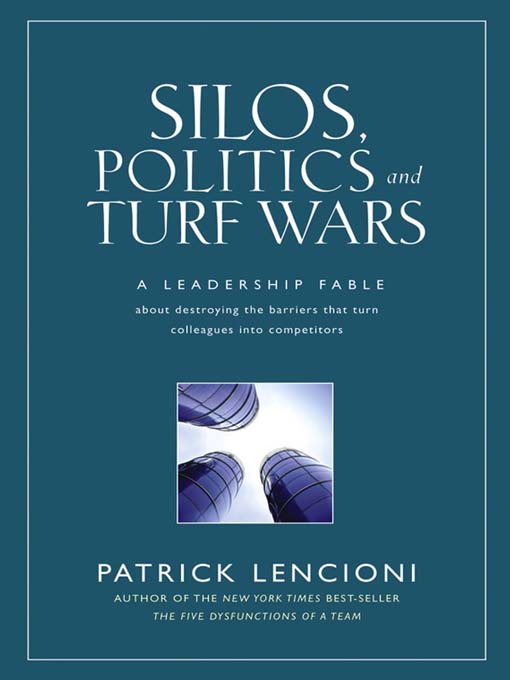
Read and Learn: Silos, Politics and Turf Wars

Even though I heard Patrick Lencioni speak at the Willow Creek Leadership Summit last fall and was very impressed by him, I didn’t put two and two together when I first started reading his newest book, Silos, Politics and Turf Wars, for a campus book discussion. It wasn’t until I opened up the back cover that I thought Hey, I recognize this guy. At that point, I knew it was going to be a worthwhile read.

In Silos, Politics and Turf Wars, Lencioni spends 170 pages building a narrative that draws the reader in and frames his argument. Fictional character Jude leaves his job at a large corporation and sets out to make it as a consultant. His first handful of clients is a diverse bunch, and it’s crucial that he quickly figure out what it is that he can contribute to their unique business environments. You’ll have to read the book to find out the rest of the narrative!

The last 40 pages of the book transition to a more familiar business book structure. Lencioni posits that conquering organizational silos is the best way he can help to develop healthy leadership teams and, therefore, healthy businesses

His model for addressing silos is to rally the leadership team around a thematic goal and several sub-objectives over a fairly short period of time – anywhere from a month for a startup company to a year in an academic environment. Although one person on the leadership team may be more familiar with a particular sub-objective, it’s the entire leadership team’s responsibility to accomplish the thematic goal. Each leadership team member must carry the thematic goal battle cry back to his or her unit so that the entire organization moves toward the shared goal together.

“The thematic goal is not a number, and it is not even specifically measurable. It is a general statement of a desired accomplishment. It requires a verb, because it rallies people to do something. Improve, reduce, increase, grow, change, establish, eliminate, accelerate,” he writes.

This book is a must-read for anyone in a leadership position. Even if your work environment isn’t a Microsoft or a Google, most medium and large organizations – and even some small ones – contain silos and would be wise to test and adopt Lencioni’s approach.